What rights does a family member of a Spanish citizen have?
17 November 2026
Residence as a family member of a Spanish citizen grants five years of residency and work authorization. We'll tell you what you need to provide, where to apply, and what to do if the consulate denies the visa.

Many people who are already Spanish citizens ask themselves the same question: What rights does a family member of a Spanish citizen have? There is no single answer. It varies depending on who that family member is and depending on where Residence is requested.
When temporary residence is granted to a family member of a Spanish citizen, the rights of that permit are as follows:
Legal residence for five years in Spain.
Five-year work permit, as an employee and as a self-employed person.
Travel for up to ninety days within European territory.
When you are making contributions, registration with Social Security and, after the corresponding period of time, the possibility of a retirement benefit.
Possibility of traveling abroad, including outside the European Union.
These effects are recognized by the Immigration Regulations (Royal Decree 1155/2024) for this authorization. The documents and the place from which the application is submitted do depend on the family relationship and whether the person is already in Spain.
What to provide
In general, the application for residence as a family member of a Spanish citizen requires:
Full passport of the applicant.
Spanish citizen's DNI (national ID card).
Registration of the Spanish citizen.
Document proving the family relationship, with apostille.
If the applicant is of legal age, a criminal record, also with an apostille.
If the process is carried out while already in Spain, the applicant must be registered with the Spanish family member.
There are more documents depending on the case: the file is not the same for a spouse, a child, or an ascendant. It is advisable to check this before submitting.
It can be applied for in Spain or from abroad.
The application can be made from Spanish territory and also with the family member still abroad. In the latter case, that person must be in a country of which they are a national or in which they have legal residence.
If you are in a country where you do not have legal residency, the approval from the Immigration Office does not allow you to apply for a visa there. You will have to go to your country of origin, or to the country where you do legally reside, and apply for the visa at the Spanish consulate or embassy.
With the approved visa, travel to Spain and apply for the Foreigner Identity Card (TIE).
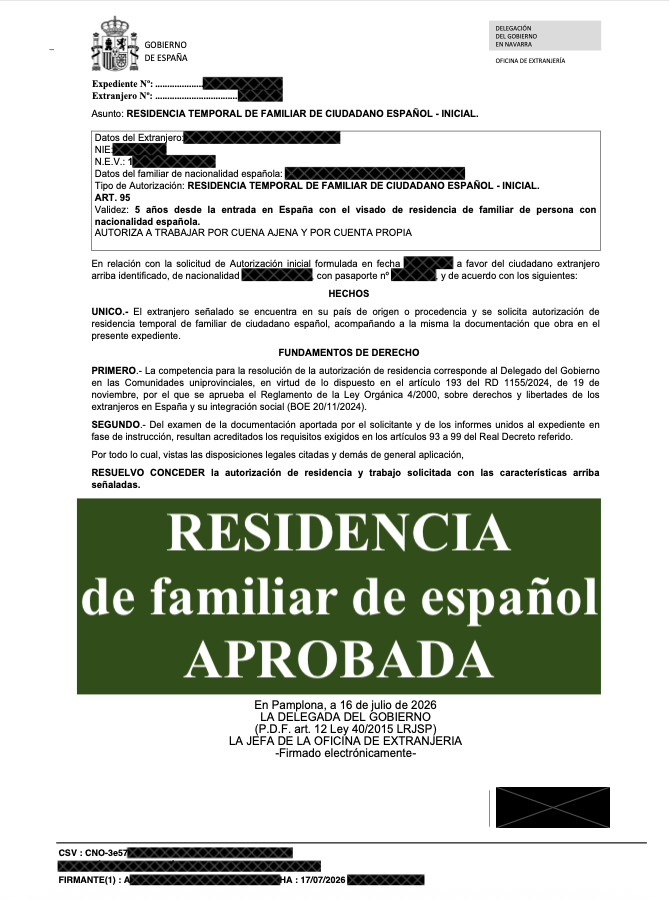
A real-life case, application made from the country of origin
This decision grants temporary residence as a family member of a Spanish citizen to a person who was in their country of origin. It is valid for five years from the date of entry into Spain with the visa, and authorizes the holder to work as an employee and as a self-employed person. Personal data is hidden.
If Spain approves and the consulate denies the visa
You must read the reasons for the denial and defend the case based on them. There are two options, the same ones that we explain in appeals against immigration denials:
Administrative appeal for reconsideration. This is the administrative appeal, before the Administration itself.
Administrative appeal. This is legal representation before a court.
The firm reviews the case file and recommends the most useful course of action for that person. For most of these visas, we opt for judicial defense before the court in Madrid: the administrative route usually confirms the denial.
Can the visa be denied?
Yes. The official can deny the request. That does not exempt him from justifying the decision. The principle of legality requires that approval and denial be based on articles in force, and that the reasoning does not harm the applicant.
In many visa denials, this justification is lacking, or concepts that are not the same are mixed up. This may violate the rights of the applicant. That is why legal representation is provided by a court representative and a lawyer licensed in Spain.
If you already have the decision, from Spain or from the consulate, the deadline for appealing starts from the date of notification. Request a consultation or write to us on WhatsApp and we'll see if the family member can order now, and from which country.